Grid Inhomogeneous Solvation Theory (GIST)
Simulate and map local binding-site hydration thermodynamics with a reproducible OpenMM and cpptraj GIST workflow.
Overview
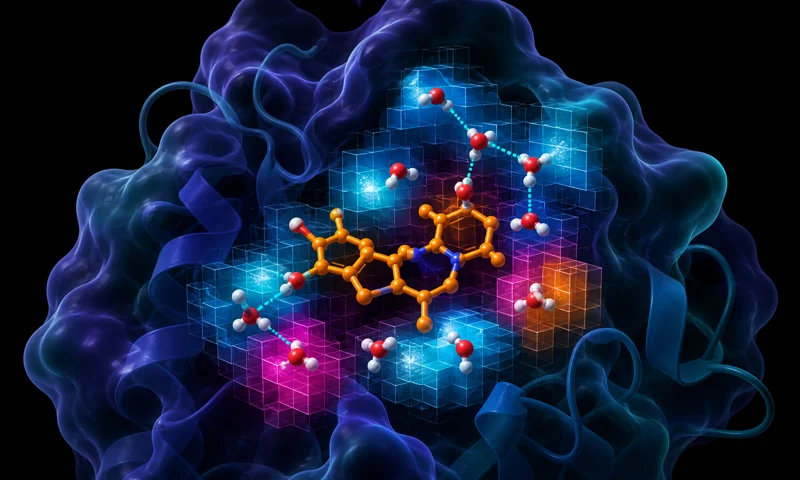
Run a self-contained, restrained explicit-water molecular dynamics simulation and analyze binding-site hydration with cpptraj Grid Inhomogeneous Solvation Theory. The workflow uses a fixed AMBER14SB, GAFF2, TIP3P, and OpenMM stack and returns spatial density, energy, entropy, ordering, and convergence artifacts.
Run Grid Inhomogeneous Solvation Theory (GIST) on Neurosnap
The Grid Inhomogeneous Solvation Theory (GIST) online webserver allows anybody with a Neurosnap account to run and access Grid Inhomogeneous Solvation Theory (GIST), no downloads required. Information submitted through this webserver is kept confidential and never sold to third parties as detailed by our strong Terms of Use and Privacy Policy.
Features
- Runs protein preparation, explicit TIP3P solvation, equilibration, production MD, and cpptraj GIST in one job.
- Supports apo hydration maps centered by a reference ligand pose and holo maps that include the GAFF2-parameterized ligand.
- Returns Amber topology and coordinate files, the explicit-water trajectory, checkpoints, raw voxel tables, and OpenDX grids.
- Compares the first half of the production trajectory with the full trajectory to provide descriptive sampling-stability diagnostics.
- Uses weak positional restraints and grid RMS fitting to keep the solute and analysis region in a stable reference frame.
Statistics
Neurosnap periodically calculates runtime statistics based on job execution data. These estimates provide a general guideline for how long your job may take, but actual runtimes can vary significantly depending on factors like input size or settings used.
| Statistic | Value |
|---|---|
| Credit Usage Rate | loading... |
| Estimated Total Cost | loading... |
| Runtime Mean | loading... |
| Runtime Median | loading... |
| Runtime Standard Deviation | loading... |
| Runtime 90th Percentile | loading... |
| Runtime Longest | loading... |
API Request
Access Grid Inhomogeneous Solvation Theory (GIST) using the Neurosnap API by sending a request using any programming language with HTTP support. To safely generate an API key, visit the API tab of your overview page.
Similar Tools
Explore tools with similar features, categories, and use cases.
Citations
Please cite the original work when using Grid Inhomogeneous Solvation Theory (GIST) in publications or research outputs.
|
Nguyen, C.N., Kurtzman Young, T. and Gilson, M.K. Grid inhomogeneous solvation theory: Hydration structure and thermodynamics of the miniature receptor cucurbit[7]uril. The Journal of Chemical Physics, 2012, 137, 044101. https://doi.org/10.1063/1.4733951. |
|
Ramsey, S. et al. Solvation Thermodynamic Mapping of Molecular Surfaces in AmberTools: GIST. Journal of Computational Chemistry, 2016. https://doi.org/10.1002/jcc.24417. |
|
Eastman, P. et al. OpenMM 7: Rapid development of high performance algorithms for molecular dynamics. PLOS Computational Biology, 2017. https://doi.org/10.1371/journal.pcbi.1005659. |
|
Neurosnap Inc. (2022). Neurosnap: An online platform for computational biology and chemistry. Available at: https://neurosnap.ai/ |