ESMC Feature Interpretation
Interpret residue-level biological patterns learned by ESMC using sparse autoencoder features.
Overview
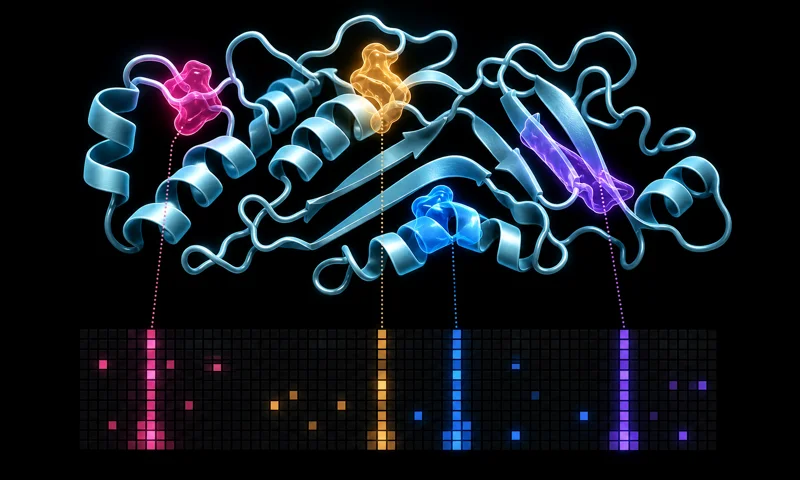
ESMC Feature Interpretation applies Biohub's sparse autoencoder to residue representations from ESMC-6B. It ranks learned features by maximum activation, reports how broadly each feature occurs across the sequence, and provides residue-level activation profiles. These features are exploratory hypotheses about patterns learned by ESMC rather than experimentally validated functional annotations.
Run ESMC Feature Interpretation on Neurosnap
The ESMC Feature Interpretation online webserver allows anybody with a Neurosnap account to run and access ESMC Feature Interpretation, no downloads required. Information submitted through this webserver is kept confidential and never sold to third parties as detailed by our strong Terms of Use and Privacy Policy.
Features
- ESMC-6B layer-60 representations interpreted with a sparse autoencoder containing 16,384 learned features.
- MIT-licensed Biohub descriptions, categories, activation patterns, exemplar families, and reliability thresholds for all 16,384 features.
- Ranks learned features by peak activation and summarizes their prevalence across the protein sequence.
- Sparse residue-level activation tables preserve one-based biological sequence positions.
- Optional TF-IDF-style normalization emphasizes rarer, more distinctive learned features.
Statistics
Neurosnap periodically calculates runtime statistics based on job execution data. These estimates provide a general guideline for how long your job may take, but actual runtimes can vary significantly depending on factors like input size or settings used.
| Statistic | Value |
|---|---|
| Credit Usage Rate | loading... |
| Estimated Total Cost | loading... |
| Runtime Mean | loading... |
| Runtime Median | loading... |
| Runtime Standard Deviation | loading... |
| Runtime 90th Percentile | loading... |
| Runtime Longest | loading... |
API Request
Access ESMC Feature Interpretation using the Neurosnap API by sending a request using any programming language with HTTP support. To safely generate an API key, visit the API tab of your overview page.
Similar Tools
Explore tools with similar features, categories, and use cases.
Citations
Please cite the original work when using ESMC Feature Interpretation in publications or research outputs.
|
Candido, Salvatore, Thomas Hayes, Alexander Derry, et al. “Language Modeling Materializes a World Model of Protein Biology.” Preprint, bioRxiv, June 4, 2026. https://doi.org/10.64898/2026.06.03.729735. |
|
Neurosnap Inc. (2022). Neurosnap: An online platform for computational biology and chemistry. Available at: https://neurosnap.ai/ |