BindFilter
Fold and score many binder candidates with a unified, machine-readable output.
Overview
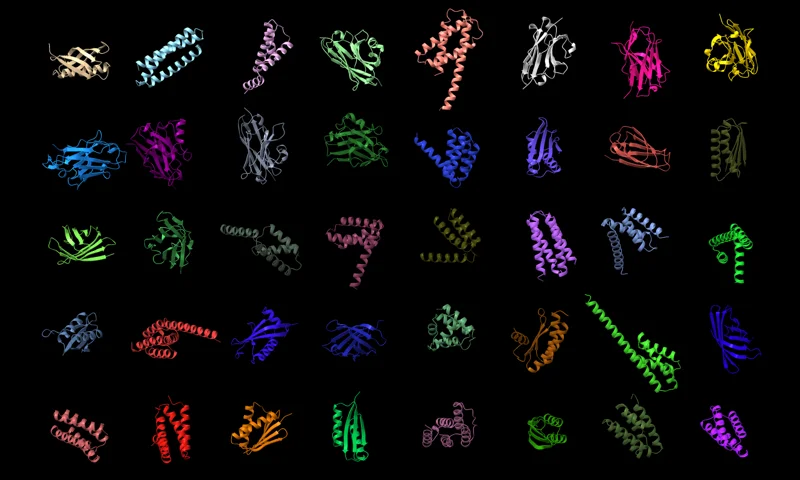
Compare protein, antibody, and peptide binder candidates against a shared target assembly with BindFilter. Predict target–binder complexes, assess interface confidence, and select relevant developability and structural analyses. Review candidate-level results together to prioritize diverse sequences for experimental testing.
Run BindFilter on Neurosnap
The BindFilter online webserver allows anybody with a Neurosnap account to run and access BindFilter, no downloads required. Information submitted through this webserver is kept confidential and never sold to third parties as detailed by our strong Terms of Use and Privacy Policy.
Features
- Predict each binder candidate with the shared target assembly using Chai-1, Boltz-2, Mol-1, or OpenDDE.
- Compare interface confidence, structural assessments, and selected property predictions in one candidate table.
- Choose relevant analyses for protein, antibody, or eligible short-peptide candidate libraries.
- Outputs one PDB per binder plus dedicated JSON files for detailed mutation-level tables.
Statistics
Neurosnap periodically calculates runtime statistics based on job execution data. These estimates provide a general guideline for how long your job may take, but actual runtimes can vary significantly depending on factors like input size or settings used.
| Statistic | Value |
|---|---|
| Credit Usage Rate | loading... |
| Estimated Total Cost | loading... |
| Runtime Mean | loading... |
| Runtime Median | loading... |
| Runtime Standard Deviation | loading... |
| Runtime 90th Percentile | loading... |
| Runtime Longest | loading... |
API Request
Access BindFilter using the Neurosnap API by sending a request using any programming language with HTTP support. To safely generate an API key, visit the API tab of your overview page.
Similar Tools
Explore tools with similar features, categories, and use cases.
Citations
Please cite the original work when using BindFilter in publications or research outputs.
|
Amani, Keaun, and Danial Gharaie Amirabadi. 2024. Neurosnap SDK Package. Software. https://github.com/NeurosnapInc/neurosnap. |
|
Passaro, S., Corso, G., Wohlwend, J., Reveiz, M., Thaler, S., Somnath, V. R., Getz, N., Portnoi, T., Roy, J., Stark, H., Kwabi-Addo, D., Beaini, D., Jaakkola, T., & Barzilay, R. (2025). Boltz-2: Towards Accurate and Efficient Binding Affinity Prediction. |
|
Mirdita, M., Schütze, K., Moriwaki, Y., Heo, L., Ovchinnikov, S., & Steinegger, M. (2022). ColabFold: making protein folding accessible to all. Nature Methods. |
|
Chai Discovery, Jacques Boitreaud, Jack Dent, Matthew McPartlon, Joshua Meier, Vinicius Reis, Alex Rogozhnikov, Kevin Wu bioRxiv 2024.10.10.615955; doi: https://doi.org/10.1101/2024.10.10.615955 |
|
Molence Bio. Mol-1: Open Frontier Biomolecular Intelligence. Official repository and technical report. https://github.com/molence/Mol-1. |
|
Aureka AI Research. OpenDDE official repository. https://github.com/aurekaresearch/OpenDDE. |
|
Vangone, A. and Bonvin, A. M. J. J. (2017). PRODIGY: A Contact-based Predictor of Binding Affinity in Protein-protein Complexes. Bio-protocol 7(3): e2124. DOI: 10.21769/BioProtoc.2124. |
|
Vangone, A., and Bonvin, A. M. J. J. (2015). Contacts-based prediction of binding affinity in protein-protein complexes. eLife 4: 291. |
|
Huang X, Pearce R, Zhang Y. EvoEF2: accurate and fast energy function for computational protein design. Bioinformatics. 2020 Feb 15;36(4):1135-42. |
|
Gharaie Amirabadi D, Jackson C, Kim DS, Sprang M, Amani K. Prot2Prop: Structure-informed multitask protein property prediction. bioRxiv (2026). https://doi.org/10.64898/2026.06.28.735009 |
|
Thumuluri, V., Martiny, H.M., Almagro Armenteros, J., Salomon, J., Nielsen, H., & Johansen, A. (2021). NetSolP: predicting protein solubility in Escherichia coli using language models. Bioinformatics, 38(4), 941-946. |
|
Aleksander Kuriata, Valentin Iglesias, Jordi Pujols, Mateusz Kurcinski, Sebastian Kmiecik, Salvador Ventura, Aggrescan3D (A3D) 2.0: prediction and engineering of protein solubility, Nucleic Acids Research, Volume 47, Issue W1, 02 July 2019, Pages W300–W307, https://doi.org/10.1093/nar/gkz321 |
|
Pudžiuvelytė, I. et al. "TemStaPro: protein thermostability prediction using sequence representations from protein language models", https://academic.oup.com/, 04 April 2024, https://academic.oup.com/bioinformatics/article/40/4/btae157/7632735. |
|
Gajendra, P.S. R. et al., ToxinPred 3.0: An improved method for predicting the toxicity of peptides, https://www.biorxiv.org, 14 August 2023, https://www.biorxiv.org/content/10.1101/2023.08.11.552911v1. |
|
Article Source: OpenMM 7: Rapid development of high performance algorithms for molecular dynamics Eastman P, Swails J, Chodera JD, McGibbon RT, Zhao Y, et al. (2017) OpenMM 7: Rapid development of high performance algorithms for molecular dynamics. PLOS Computational Biology 13(7): e1005659. https://doi.org/10.1371/journal.pcbi.1005659 |
|
ff14SB: Improving the Accuracy of Protein Side Chain and Backbone Parameters from ff99SB James A. Maier, Carmenza Martinez, Koushik Kasavajhala, Lauren Wickstrom, Kevin E. Hauser, and Carlos Simmerling Journal of Chemical Theory and Computation 2015 11 (8), 3696-3713 DOI: 10.1021/acs.jctc.5b00255 |
|
Jorgensen, W. L., Chandrasekhar, J., Madura, J. D., Impey, R. W., & Klein, M. L. (1983). Comparison of simple potential functions for simulating liquid water. The Journal of Chemical Physics, 79(2), 926–935. https://doi.org/10.1063/1.445869 |
|
McInnes, L, Healy, J, UMAP: Uniform Manifold Approximation and Projection for Dimension Reduction, ArXiv e-prints 1802.03426, 2018. |
|
Ester, M., Kriegel, H.-P., Sander, J., & Xu, X. (1996). A Density-Based Algorithm for Discovering Clusters in Large Spatial Databases with Noise. Proceedings of the Second International Conference on Knowledge Discovery and Data Mining, 226–231. Portland, Oregon: AAAI Press. |
|
Neurosnap Inc. (2022). Neurosnap: An online platform for computational biology and chemistry. Available at: https://neurosnap.ai/ |