StaB-ddG
Fast & accurate deep learning model for predicting binding ∆∆G using folding energy principles and a ProteinMPNN-based inverse folding framework.
Overview
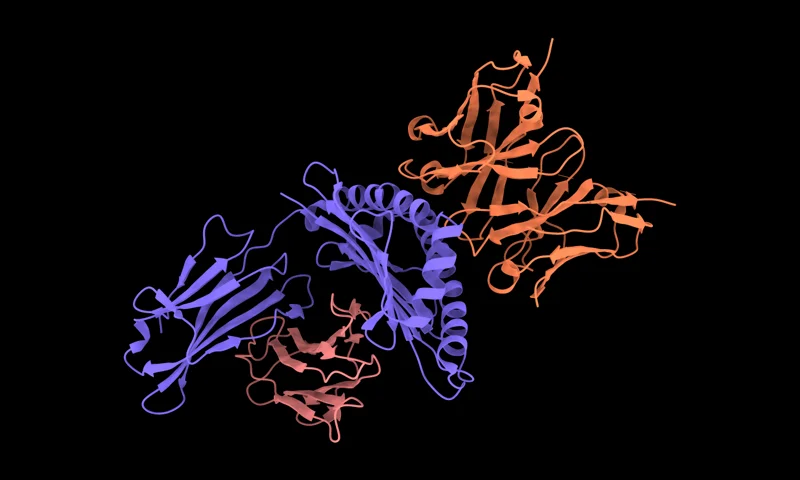
StaB-ddG is a deep learning model for predicting mutational effects on protein–protein binding affinity, achieving performance on par with state-of-the-art force field methods while being over 1000× faster. Built on a thermodynamic identity linking binding free energy to folding stability, STAB-DDG leverages a zero-shot inverse folding model (ProteinMPNN) and is fine-tuned on high-throughput folding and binding ∆∆G datasets. It incorporates variance reduction techniques and satisfies key physical constraints (antisymmetry, path-independence), offering robust performance across benchmark datasets. The model supports multi-chain complexes and multiple mutations, delivering accurate predictions for binding energy changes relevant to structural biology and therapeutic design.
Run StaB-ddG on Neurosnap
The StaB-ddG online webserver allows anybody with a Neurosnap account to run and access StaB-ddG, no downloads required. Information submitted through this webserver is kept confidential and never sold to third parties as detailed by our strong Terms of Use and Privacy Policy.
Features
- Thermodynamic parameterization defines binding ∆∆G as a difference in folding free energies.
- Initialized from ProteinMPNN inverse folding model for strong zero-shot folding stability predictions.
- Supports multi-chain complexes and multiple mutations without structural heuristics.
- Fine-tuned sequentially on large folding and smaller binding ∆∆G datasets for improved generalization.
- Satisfies antisymmetry and mutational path-independence by design, enabling physically grounded predictions.
- Variance reduction via Monte Carlo ensembling lowers inference noise.
- Outperforms prior DL predictors and matches FoldX accuracy with 1000X speedup.
- Validates across SKEMPIv2.0, de novo binder assays, and TCR-mimic antibody datasets.
Statistics
Neurosnap periodically calculates runtime statistics based on job execution data. These estimates provide a general guideline for how long your job may take, but actual runtimes can vary significantly depending on factors like input size or settings used.
| Statistic | Value |
|---|---|
| Credit Usage Rate | loading... |
| Estimated Total Cost | loading... |
| Runtime Mean | loading... |
| Runtime Median | loading... |
| Runtime Standard Deviation | loading... |
| Runtime 90th Percentile | loading... |
| Runtime Longest | loading... |
API Request
Access StaB-ddG using the Neurosnap API by sending a request using any programming language with HTTP support. To safely generate an API key, visit the API tab of your overview page.
Similar Tools
Explore tools with similar features, categories, and use cases.
Citations
Please cite the original work when using StaB-ddG in publications or research outputs.
|
Deng A, Householder K, Wu F, Thrun S, Garcia KC, Trippe B. Predicting mutational effects on protein binding from folding energy. arXiv preprint arXiv:2507.05502. 2025 Jul 7. |
|
Neurosnap Inc. (2022). Neurosnap: An online platform for computational biology and chemistry. Available at: https://neurosnap.ai/ |